The wonders of the Chinese market
The auto industry is valued at over $3 billion, and expected to be worth twice as much in 10 years. In 2024, about 67 million passenger vehicles were produced, with major automakers like Toyota accounting for nearly 11 million. To that, making 500,000 cars in a year and a half might not seem like a significant feat, but it is – especially when you’re an upstart brand with limited reach.
Xiaomi, a brand most often associated with manufacturing smartphones and other personal electronics, is now making cars. It began making EVs in April 2024 and set a sales goal of 350,000 for 2025. It blew past that in a big way, and has announced it has already shipped 500,000 EVs since its first rolled off the production line.
Xiaomi
Xiaomi the money
Xiaomi (pronounced “show me”) says its November deliveries exceeded 40,000 units, a massive feat given its average monthly target of 29,166. As an automaker, Xiaomi says it has already produced and shipped over 500,000 units since April 2024, when it began producing its YU7 crossover. Xiaomi has two plants: Phase 1, a smaller facility, and Phase 2, a larger plant capable of producing cars in large numbers. The YU7 quickly became so popular that Xiaomi had to relocate production to its Phase 2 factory.
YU7 is seen by many as a competitor to the Tesla Model Y, though Xiaomi hasn’t quite matched Tesla’s prowess in EV manufacturing. Buyers originally had to wait up to 62 weeks for a YU7, and the current wait time is about 36 weeks. Still, the Xiaomi YU7 is beating the Tesla Model Y in China, selling 33,662 units in October 2025, while the Tesla Model Y saw only 26,100 sales, according to the China Passenger Car Association.
Xiaomi Group’s third-quarter profit is 113.1 billion yuan, or $16 billion, a 22% increase over Q3 2024. Net profit was also up 81% to $1.6 billion. Total revenue from EVs and AI (Xiaomi lumps these items together on its earnings sheets) was $4.1 billion in Q3 2025. In its recent earnings call, Xiaomi revised its total 2025 EV production to 400,000 units and said it will ship EVs internationally in 2027.
The issue with Xiaomi
When Xiaomi made its first smartphone, the Mi 1, it was primarily seen as a clone of Apple’s iPhone. Its hardware, software, aesthetics, and marketing were eerily similar to Apple’s efforts. Because of this, Xiaomi never came stateside as it was widely believed that if Xiaomi did sell phones in the U.S., Apple would sue the company into oblivion. You still can’t officially buy a Xiaomi smartphone in the United States.
Xiaomi plans to sell EVs outside of China in 2027, but says it will focus on the European market. Given its history, and that its YU7 is stylistically very close to a Model Y – not to mention the Xiaomi SU7 sedan is head-scratchingly similar to a Tesla Model 3 aesthetically – it’s safe to assume Xiaomi EVs will never make it stateside.
Xiaomi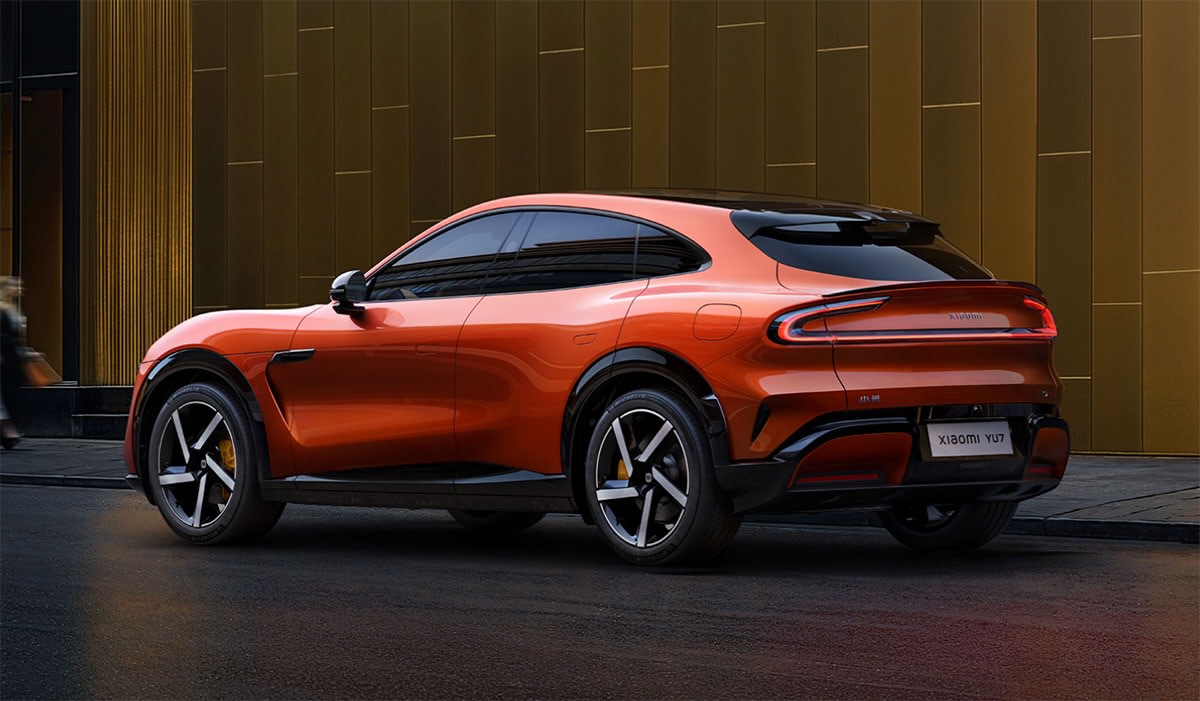
Final thoughts
China’s EV market is booming, and Xiaomi is a Chinese company. It’s easy to see why the brand is so popular in China, and how it exceeded expectations for EV deliveries. Think of it like the “Apple Car” that never was. If Apple had followed through on making an actual EV, people would have bought it just because of Apple’s brand halo of quality. Xiaomi has a similar effect in China.
